What an Average Ring Size Means
An average describes a group, not the dimensions of one person's finger. Published retail guides often report a common men's range around US 9 to 11, but the figures usually come from sales or inventory experience rather than a representative population study. Treat that range as shopping context and attribute it to the named retailer, not as a biological rule.
Fred Meyer Jewelers publishes an approximate men’s size of 10 in its sizing guide. That named retail reference is useful for inventory context, but its document does not establish a population sample or confidence interval. This page therefore avoids presenting one number as a universal fact.
Different Fingers Have Different Sizes
A ring finger, index finger, and little finger carry different dimensions. Even the corresponding finger on the other hand may differ. A remembered size without a finger and hand label is incomplete evidence. Measure the exact location where the ring will sit.
Knuckle Width Changes the Decision
A prominent knuckle can require enough space for the ring to pass while leaving excess room at the base. Finger gauges reveal this conflict better than demographic averages. Jewellers may suggest a different profile or a reversible sizing aid rather than forcing the base measurement to do both jobs.
Finger Shape Affects Stability
Some fingers taper steadily toward the hand; others have a defined joint and narrower base. A top-heavy signet ring can rotate on a tapered finger even when it clears the knuckle. The shape of the finger and weight distribution of the design affect fit independently of the nominal size.
Temperature and Time of Day
Hands change temporarily with cold, heat, activity, and fluid retention. One reading during unusual conditions can misrepresent everyday fit. Measure on separate occasions and record the range. Professional advice is appropriate when swelling varies widely or has a medical cause.
Band Width and Inside Profile
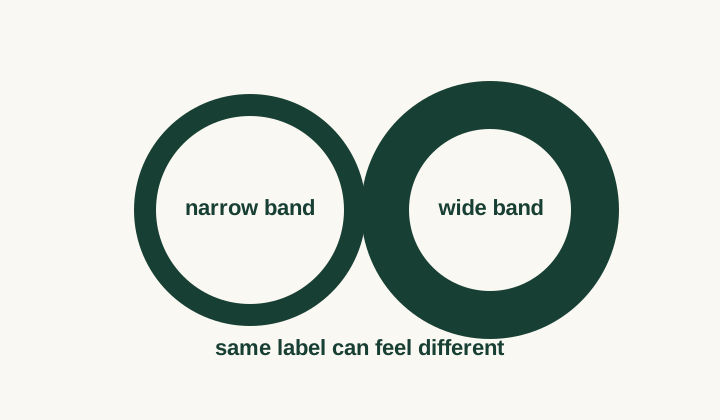
A broad wedding band covers more skin than a narrow gauge and often feels tighter. A rounded comfort-fit interior can behave differently from a flat wall. Ask the manufacturer how its finished band relates to standard gauges, especially when the width exceeds 4 mm.
Manufacturer Sizing and Tolerance
Nominal labels are useful only alongside actual dimensions and manufacturing tolerances. Two rings labelled US 10 may not feel identical if their width, thickness, interior shape, or roundness differs. Use the seller's chart and inspect the exchange terms before committing.
Why Height, Weight, Shoes, and Gloves Cannot Predict a Size
Broad body measurements do not reveal the internal diameter needed for a particular finger. People with similar height or shoe size can have different bones, joints, tissue distribution, and dominant-hand development. These proxies may narrow a surprise-shopping guess, but they cannot replace a ring or finger measurement.
Measure Instead of Guessing
A professional gauge takes minutes and gives a result tied to the intended finger. If that is unavailable, borrow a round ring worn on that finger and measure its inside diameter. A calibrated printable tool is a third option. Repeat any home measurement and use the calculator for the nearest supported row.
Buying a Surprise Ring
Borrow a ring discreetly only if you know which finger and hand it fits. Trace its inside opening, press it into removable putty, or take it to a jeweller. Ask a trusted person who may know the size. Avoid comparing it with your own fingers; that creates an unquantified guess.
Choose an Exchange-Friendly Purchase
When measurement is impossible, favour a seller with a clear exchange policy and a design that can be resized. Ask about fees, time limits, engraving, stone coverage, metal restrictions, and return shipping. Keep the ring unaltered until the recipient tries it under normal conditions.
When Professional Sizing Is Needed
Professional sizing is the sensible final step for an expensive or custom ring, fluctuating swelling, a large knuckle, an unusually wide band, or a design that cannot readily be altered. Bring any well-fitting ring and the proposed design details so the jeweller can compare geometry rather than provide a bare number.
A Practical Next Step
Use an estimate only to plan. For the purchase itself, follow the measurement guide, record the finger and hand, and confirm the proposed band width with the seller.
The Evidence Behind Typical Ranges
Most public numbers come from jewellers, retailers, or sales guides. Those sources can describe what they sell, but they rarely publish a sampling frame, population weighting, age distribution, or uncertainty range. A commonly purchased size is not necessarily a population mean. This guide names the retail source for the approximate size 10 reference and avoids converting it into a claim about all men.
Why Country Comparisons Are Weak
Different markets use different labels, stock different ranges, and serve different customer groups. A UK letter cannot be compared with a US number until both are tied to dimensions. Even then, a retailer's sales mix may reflect its styles and marketing rather than local anatomy. Use the international chart to translate measurements, not to rank countries by finger size.
Age Does Not Supply a Size
Hands may change over time through growth, work, injury, arthritis, fluid retention, or changes in tissue. Age alone cannot quantify those effects for one finger. Remeasure before replacing an old wedding band or ordering a commemorative ring, particularly if the original ring no longer passes the joint comfortably.
Dominant Hand and Occupation
The dominant hand can differ from the other, and repetitive manual work may affect joints or tissue. Neither fact provides a fixed adjustment. A right-handed person ordering for the left ring finger should measure that left finger. Gloves, keyboard work, lifting, and tool use do not translate into universal ring-size formulas.
Choosing Stock for a Group
An event organiser or costume department may need a range without individual measurements. Use supplier sales data only to plan a spread, include half sizes or adjustable designs, and create an exchange process. Do not assign size from appearance. For a permanent ring, measure each wearer and record the finger, hand, band width, and result.
Surprise Proposals and Temporary Settings
A proposal ring can be presented in a temporary or resizable setting when exact sizing would spoil the surprise. Ask the jeweller which designs tolerate adjustment and which stone layouts restrict it. The recipient can then choose the final fit with professional gauges. This protects the surprise without pretending an average is precise.
Fit Matters More Than the Label
A secure ring should resist accidental loss while remaining removable over the knuckle. The same label may feel stable in a broad, balanced band and rotate in a heavy signet. Evaluate movement, pressure, removal, and normal daily variation. A person can be “average” by one retail statistic and still need a different size for each design.
Keeping Better Sizing Records
Store the date, hand, finger, base and knuckle readings, measurement tool, sample width, and internal diameter of a successful ring. Add the maker and model when available. This record turns a vague remembered label into useful evidence for the next purchase. Repeat the measurement if years have passed or the new design differs substantially.
Questions to Ask the Seller
Ask which sizing system it uses, whether the chart describes finished inside diameter, how comfort fit is handled, what manufacturing tolerance applies, which materials can be resized, and whether engraving changes returns. Ask for a physical sizer for custom work. Clear answers reduce reliance on general averages and make any later correction easier to discuss.
Retail Averages and Selection Effects
A store selling broad men's wedding bands sees a different set of customers from a shop focused on signet rings or inclusive extended sizes. Stock limits also shape sales: customers cannot buy sizes a retailer does not carry. These effects make sales-derived averages useful to that store but weak as universal evidence. A named retail estimate can guide initial stock or a surprise-ring backup plan, never identify an individual.
Finger Size Is Not a Health Label
Ring size describes an opening required at a particular finger. It does not classify body shape, masculinity, fitness, or health. Bone structure, joint width, tissue, temperature, and ring geometry all affect the result. Avoid language such as small, large, or chubby when it adds judgement instead of measurement. State the US label and millimetre dimensions.
Comparing the Ring Finger with the Index Finger
An index ring often needs a different opening from a wedding band, and the dominant hand may alter the comparison. A person who wears US 10 on one ring finger cannot safely transfer that number to every finger. Repeat the fitting with the actual design on the intended location. This is especially relevant for signet rings, whose weight can expose rotation that a thin gauge does not.
Planning an Engraved Ring
Engraving may restrict exchange, and resizing can disturb lettering or surface finishes. Confirm the size with a representative gauge before personalisation. Ask the maker whether the engraving is applied before or after final sizing and how much alteration the design permits. Delay engraving until after a trial when the seller offers that option.
Temporary Fit Changes
Travel, climate, exercise, diet, and ordinary fluid shifts can change how a ring feels for a time. Do not treat one loose cold-day fit as proof that the original size was wrong. Record repeated measurements under normal conditions and use safe temporary sizing aids only with professional guidance. Persistent or painful swelling calls for medical attention, not an average-size chart.
A Better Surprise-Buying Workflow
First identify the finger and hand. Borrow a known ring if possible and measure its inside diameter. Check the intended band width, choose a material and setting that can be altered, and read the full exchange policy. Tell the seller that the size is provisional. Arrange a professional fitting with the recipient before engraving or permanent modification.
Final verification step
Average-size claims can also exclude people at the edges of a retailer's range. If a shop stocks only US 7 through 13, its orders cannot describe customers who need smaller or larger sizes. Inclusive fitting requires access to extended gauges and custom options, not pressure to accept the closest stocked number.
Couples buying rings together should measure each person independently. Shared height, build, age, or family relationships do not create shared finger dimensions. The same person may also need different sizes for a wedding band and a wide signet because the contact area and weight distribution differ.
A changing old ring is another source of misleading averages. A band may have been resized, worn thin, bent, or made under a different regional convention. Measure its current opening and inspect its shape before using the stamped or remembered label.
For online purchases, ask the seller to mail a physical sizer that matches its production system. Use it on the intended finger across ordinary conditions, then return the chosen size in writing. This replaces demographic guessing with direct evidence.
Use averages only to plan uncertainty
If the recipient wears several rings, identify which finger and hand each reference belongs to before measuring. A comfortable index ring does not predict a wedding band, and the same finger on the other hand may differ. Finger identity stays attached to the measurement.
Typical ranges can help a shop plan sample gauges or remind a gift buyer to expect an exchange. They cannot turn height, weight, shoe size, glove size, age, or a photograph into an individual size. Build the purchase around measurement and correction instead of confidence in the estimate. Keep the first fitting provisional until the wearer tests the actual band.
Sources and methodology
Dimensions are derived from inside circumference and rounded consistently. International labels are practical equivalents because national scales do not share every increment.