| US / Canada | UK / Australia* | EU* | Inside diameter | Inside circumference |
|---|---|---|---|---|
| 3 | F | 44 | 14.1 mm (0.554 in) | 44.2 mm (1.740 in) |
| 3.5 | G | 46 | 14.5 mm (0.570 in) | 45.5 mm (1.791 in) |
| 4 | H | 47 | 14.9 mm (0.586 in) | 46.8 mm (1.843 in) |
| 4.5 | I | 48 | 15.3 mm (0.602 in) | 48.0 mm (1.890 in) |
| 5 | J ½ | 49 | 15.7 mm (0.618 in) | 49.3 mm (1.941 in) |
| 5.5 | K ½ | 51 | 16.1 mm (0.634 in) | 50.6 mm (1.992 in) |
| 6 | L ½ | 52 | 16.5 mm (0.650 in) | 51.9 mm (2.043 in) |
| 6.5 | M ½ | 53 | 16.9 mm (0.665 in) | 53.1 mm (2.091 in) |
| 7 | N ½ | 54 | 17.3 mm (0.682 in) | 54.4 mm (2.142 in) |
| 7.5 | O ½ | 56 | 17.7 mm (0.698 in) | 55.7 mm (2.193 in) |
| 8 | P ½ | 57 | 18.1 mm (0.714 in) | 57.0 mm (2.244 in) |
| 8.5 | Q ½ | 58 | 18.6 mm (0.731 in) | 58.3 mm (2.295 in) |
| 9 | R ½ | 60 | 18.9 mm (0.746 in) | 59.5 mm (2.343 in) |
| 9.5 | S ½ | 61 | 19.4 mm (0.762 in) | 60.8 mm (2.394 in) |
| 10 | T ½ | 62 | 19.8 mm (0.778 in) | 62.1 mm (2.445 in) |
| 10.5 | U ½ | 63 | 20.2 mm (0.795 in) | 63.4 mm (2.496 in) |
| 11 | V ½ | 65 | 20.6 mm (0.810 in) | 64.6 mm (2.543 in) |
| 11.5 | W ½ | 66 | 21.0 mm (0.826 in) | 65.9 mm (2.594 in) |
| 12 | X ½ | 67 | 21.4 mm (0.842 in) | 67.2 mm (2.646 in) |
| 12.5 | Z | 69 | 21.8 mm (0.858 in) | 68.5 mm (2.697 in) |
| 13 | Z 1 | 70 | 22.2 mm (0.873 in) | 69.7 mm (2.744 in) |
| 13.5 | Z 2 | 71 | 22.6 mm (0.890 in) | 71.0 mm (2.795 in) |
| 14 | Z 3 | 72 | 23.0 mm (0.906 in) | 72.3 mm (2.846 in) |
| 14.5 | Z 4 | 74 | 23.4 mm (0.922 in) | 73.6 mm (2.898 in) |
| 15 | Z 5 | 75 | 23.8 mm (0.937 in) | 74.8 mm (2.945 in) |
*UK and EU entries are nearest practical equivalents. Sizing systems do not align at every step, so confirm the seller's own chart before ordering.
How to Use the Conversion Chart
Start with a known size or, preferably, a physical inside diameter or circumference. Move across that row to find the nearest label in the destination system. Treat the answer as a translation aid. If the destination maker publishes dimensions, compare those dimensions directly rather than relying on the label alone.
US and Canadian Sizes
US and Canadian sizing uses numbers with common half-size steps. The number is not the diameter or circumference. A US 9 in this dataset has a 19.0 mm inside diameter and 59.5 mm circumference, while a US 10 is 19.8 mm across and 62.1 mm around.
Quarter sizes exist in some catalogues, but this Phase 1 dataset stops at reliable half-size values. If a seller offers quarter sizes, use its own manufacturing chart and confirm whether the listing refers to standard or comfort fit.
UK and Australian Sizes
The UK and Australia commonly use letters, sometimes with half letters. Letter increments do not land exactly on every US half size. A UK label in the same row therefore means the nearest useful comparison, not a claim that two national specifications are identical.
European and ISO-Based Sizes
European labels often track inside circumference in millimetres. ISO 8653 defines ring-size measurement in relation to the circumference of a defined measuring cylinder. Retail practices still vary by country and manufacturer, so a rounded EU number should be checked against the listed circumference.
Convert Diameter into an International Size
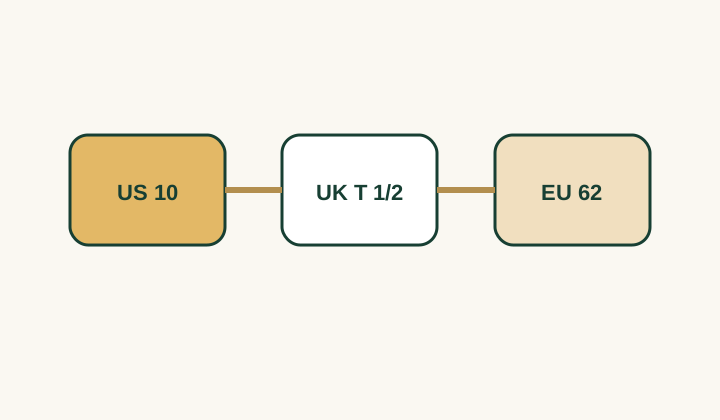
Measure the open space across a well-fitting ring from inner edge to inner edge. Find the nearest diameter in the chart and read across. A 19.8 mm opening points to US 10, approximately UK T 1/2 and EU 62 here. Never include the band metal in that measurement.
Convert Circumference into an International Size
Measure around the intended finger or use a known ring's inner circumference. A 57.0 mm circumference points to US 8, approximately UK P 1/2 and EU 57. The calculator can compare decimals without making you choose a row by eye.
Why Systems Do Not Always Match
Each scale has its own origin and step size. Rounding pushes some equivalents closer than others. Retailers may also manufacture to tolerances, use regional charts, or describe comfort-fit bands differently. Converting a printed label cannot remove these physical differences.
Worked Examples
US 9 to UK and EU
US 9 corresponds to 59.5 mm circumference in the shared dataset. The nearest listed UK comparison is R 1/2 and the rounded EU label is 60. If a retailer lists EU 59 or 60 around that point, compare its stated diameter with 19.0 mm.
EU 62 to US
An EU value of 62 suggests an inside circumference near 62 mm. The nearest dataset row is 62.1 mm, US 10. Confirm with the seller because an EU number may be rounded and product pages sometimes use a proprietary table.
UK V 1/2 to US
In this table, V 1/2 shares the row with US 11 and a 64.6 mm circumference. A different chart may place a neighbouring letter closer. The millimetre dimensions resolve that disagreement more clearly than the labels.
Confirm a Converted Size Before Buying
Ask for the ring's internal diameter, the maker's chart, and the exchange or resizing policy. Professional sizing is sensible for an expensive purchase, a wide wedding band, or a design with stones around the full circumference. Bring the proposed width to the fitting so the gauge resembles the finished piece.
Conversion Begins with a Physical Dimension
A national label is a shortcut. Inside circumference and diameter describe the opening that must fit the finger. When two conversion charts disagree, inspect the millimetre values behind each row. If a UK seller and a US seller place the same letter next to different numbers, a measured opening gives you a common reference. Ask each seller which finished diameter it supplies for the proposed size.
A Worked Diameter Conversion
Suppose a ring measures 18.5 mm across its inside. Multiplying by pi gives an approximate circumference of 58.1 mm; the measured table row is 58.3 mm because published size dimensions use standardized steps and rounding. The closest shared entry is US 8.5, approximately UK Q 1/2 and EU 58. Keep the original 18.5 mm in your order notes so the retailer can check its own table.
A Worked Circumference Conversion
A finger strip reads 64.2 mm on two attempts and 64.5 mm on a third. The cluster sits between US 10.5 at 63.4 mm and US 11 at 64.6 mm, closer to 11. The decision still depends on the knuckle and band. A wide flat band may need more room; a loose fit below a large joint may need a different solution. Ask for physical gauges rather than rounding silently.
Converting an Existing Label
If an old ring is marked only with a size, first learn which national system and maker used the mark. “Size 10” can mean different things outside North American practice. Measure the actual opening even after identifying the system. Wear, resizing, deformation, and manufacturing tolerance can separate the ring in your hand from the dimension implied by an old stamp or receipt.
Half Sizes and Missing Equivalents
US half sizes do not always land on a named UK half-letter or whole-millimetre EU value. The chart selects the closest practical label. A retailer may stock only whole sizes, which creates a second rounding decision. Compare the gap in millimetres, ask about the inside profile, and choose only after reviewing exchange or resizing options. Do not invent an exact equivalence where the destination catalogue offers none.
Manufacturer Variation
The brand's chart governs the product it manufactures. Casting, finishing, plating, and final polishing can affect the finished opening within stated tolerances. Comfort-fit interiors also change contact with the finger without changing the nominal label. Send the maker a calliper reading from a successful ring and ask which stocked size produces the closest internal diameter after finishing.
Ordering Across Borders
Write both systems on the order: for example, “US 9; target inside diameter 19.0 mm; target circumference 59.5 mm.” Confirm the currency, return address, duties, and who pays international return postage before buying. A nominal conversion is less useful if an exchange is impractical. For bespoke work, request written confirmation of the agreed internal dimension before production begins.
Resizing After Conversion
Do not assume every conversion error can be repaired. Plain precious-metal bands are often more adaptable than tungsten, ceramic, tension settings, or designs with stones around the circumference. The jeweller who will perform the work should assess the actual ring. Check the possible adjustment range before ordering and treat professional fitting as part of the purchase cost for an expensive piece.
How to Resolve Conflicting Charts
Check whether each chart uses diameter, inside circumference, or finger circumference; whether decimals are rounded; and whether the UK letters include half steps. Then compare a familiar ring on both charts. Prefer a source that states its measurement method and the product maker's current specification. If disagreement remains larger than a half size, request a physical sizer from the seller.
French and Other European Labels
Some European retailers use the inside circumference directly, while others present regional labels or rounded equivalents. Read the column heading and sizing notes before assuming that every “62” has the same meaning. If the page gives a 19.7 or 19.8 mm diameter, that physical figure is more informative than the storefront label. Ask support to confirm the finished internal dimension when the chart is ambiguous.
Australian Orders
Australian shops commonly use the UK letter system, but stock and manufacturing tables still differ. Send the letter and the metric target when ordering from abroad. If a US 10 ring fits, describe it as approximately UK/Australia T 1/2 with a 19.8 mm inside diameter and 62.1 mm circumference. The shop can then select its closest manufactured size without guessing which online conversion you followed.
Converting a Half Size
A US 9.5 row is 19.4 mm in diameter and 60.8 mm in circumference in this dataset. The chart pairs it with UK S 1/2 and rounded EU 61. If a European seller offers only 60 and 61, compare the stated diameter and ask whether the design runs tight. Keep the choice reversible until the actual wearer tests it.
Tolerance and Verification
A conversion table can be internally consistent while a finished ring lands slightly above or below its target. Ask whether the seller measures after polishing and whether its tolerance is stated in diameter or circumference. On delivery, measure the ring and try it under normal conditions before engraving. Contact the seller during the return period if the physical opening differs materially from the agreed specification.
Avoiding False Precision
Three decimal places in inches help retain a converted metric value; they do not prove that a household ruler measured to that precision. Report the tool used and its resolution. A calliper reading of 0.764 inch may support a close comparison, while a visual ruler estimate should be described more modestly. Professional gauges remain the final check for custom work.
Final verification step
A conversion is also vulnerable to stale product information. Screenshots and third-party charts may outlive a manufacturer's current sizing practice. Open the current product page, save the chart used for the order, and ask customer support to confirm any ambiguous column before payment. This creates a clear reference if the delivered ring differs from the dimensions supplied at purchase.
If a retailer requests only one label, place the metric target in the order notes or email it separately. Ask for acknowledgment rather than assuming the message was read. For a pair of rings, specify each ring independently; matching designs do not imply matching finger sizes.
After delivery, use a calliper or jeweller's mandrel to compare the physical opening with the order. A correct dimension can still feel wrong because of width or profile, while a mislabeled ring may explain an unexpected fit immediately. Keep the ring unaltered until the seller responds.
Treat the chart as a communication tool. The safest cross-border order combines a known successful ring, millimetre dimensions, the destination label, a representative width fitting, and a workable return plan.
Keep a reliable conversion record
Write down the original label, national system, source chart, date, inside diameter, and inside circumference. Keep that record unchanged if you later calculate another regional label. This prevents a rounded conversion from replacing evidence of what the original maker supplied. After resizing, measure the physical opening again rather than updating only the nominal size.
Marketplace listings sometimes repeat conversion tables without naming a source. Ask the seller for an actual inside-diameter reading and how it was taken. A ruler photograph can document alignment, but camera perspective cannot prove the value alone. Choose a protected return method when dimensions cannot be verified before purchase.
Before confirming an international order, record the source system, converted label, inside diameter, and circumference together. Ask the manufacturer which measurement controls production and retain the written answer with the receipt and exchange terms.
Sources and methodology
Dimensions are derived from inside circumference and rounded consistently. International labels are practical equivalents because national scales do not share every increment.