Quick answer
Select a US size below to see its closest EU equivalent from the site’s shared dataset. Confirm with the seller because the two systems do not align at every possible step.
US to EU ring size converter
The result comes from the same TypeScript dataset used by the main calculator and charts. No second hard-coded table is maintained for this page. That keeps diameter, circumference, US, UK and EU values synchronized.
Complete US to EU chart
| US | EU | Inside diameter | Inside circumference |
|---|---|---|---|
| 3 | 44 | 14.1 mm | 44.2 mm |
| 3.5 | 46 | 14.5 mm | 45.5 mm |
| 4 | 47 | 14.9 mm | 46.8 mm |
| 4.5 | 48 | 15.3 mm | 48 mm |
| 5 | 49 | 15.7 mm | 49.3 mm |
| 5.5 | 51 | 16.1 mm | 50.6 mm |
| 6 | 52 | 16.5 mm | 51.9 mm |
| 6.5 | 53 | 16.9 mm | 53.1 mm |
| 7 | 54 | 17.3 mm | 54.4 mm |
| 7.5 | 56 | 17.7 mm | 55.7 mm |
| 8 | 57 | 18.1 mm | 57 mm |
| 8.5 | 58 | 18.6 mm | 58.3 mm |
| 9 | 60 | 18.9 mm | 59.5 mm |
| 9.5 | 61 | 19.4 mm | 60.8 mm |
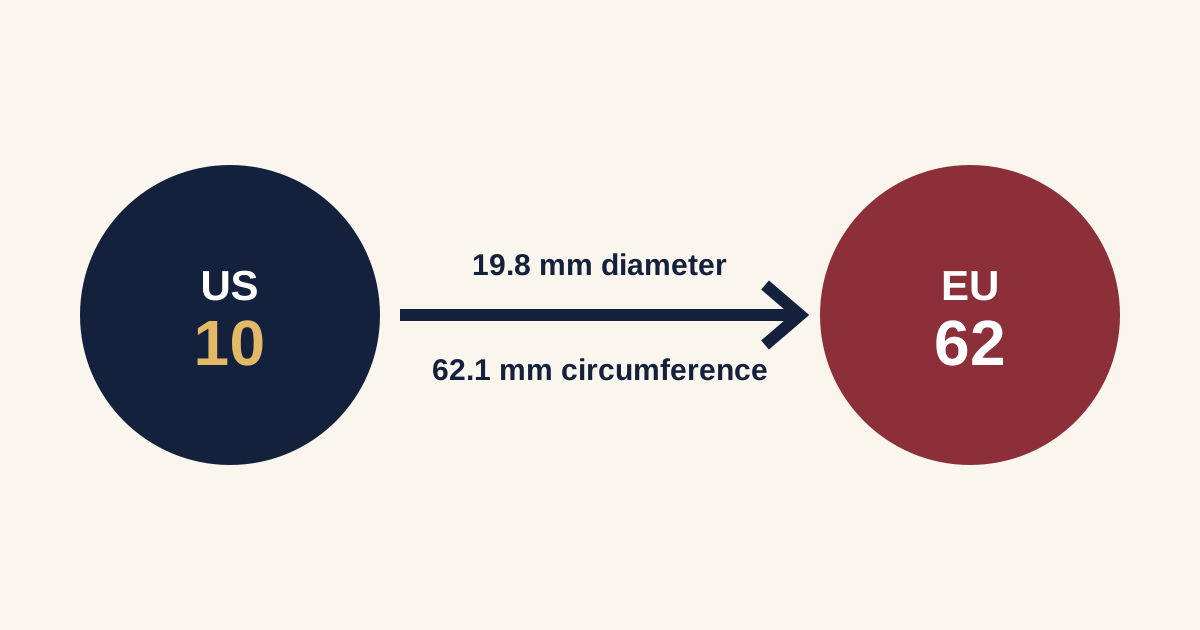
| 10 | 62 | 19.8 mm | 62.1 mm |
| 10.5 | 63 | 20.2 mm | 63.4 mm |
| 11 | 65 | 20.6 mm | 64.6 mm |
| 11.5 | 66 | 21 mm | 65.9 mm |
| 12 | 67 | 21.4 mm | 67.2 mm |
| 12.5 | 69 | 21.8 mm | 68.5 mm |
| 13 | 70 | 22.2 mm | 69.7 mm |
| 13.5 | 71 | 22.6 mm | 71 mm |
| 14 | 72 | 23 mm | 72.3 mm |
| 14.5 | 74 | 23.4 mm | 73.6 mm |
| 15 | 75 | 23.8 mm | 74.8 mm |
How the conversion works
US sizes use numbered steps and half sizes. EU sizing is commonly associated with the ring’s inside circumference in millimeters, although retail rounding and labels can vary. The systems were not designed as identical scales, so a conversion chart pairs the nearest practical entries. It does not make two manufacturers’ production tolerances identical.
Internal dimensions give the clearest common language. Diameter is a straight line across the empty opening of a round ring. Circumference is the distance around that opening. The shared chart calculates diameter from circumference by dividing by pi, then rounds values for display. Keep the original measurement when speaking with a seller instead of reporting only the converted label.
ISO 8653:2016 defines ring size measurement using a ring stick and corresponding finger-gauge set. That physical pairing is stronger evidence than a label copied between online charts. Use the converter to narrow the range, then use the seller’s current sizing kit or a jeweler’s gauge for the final decision.
Worked examples
A US size 9 in the shared chart has an inside diameter near 19.0 mm and circumference near 59.5 mm. Its closest EU label here is 60. A US size 10 is near 19.8 mm diameter and 62.1 mm circumference, paired with 62. These values are useful checks when a marketplace listing supplies both a regional label and millimeters.
If a seller lists a different equivalent, compare the internal diameter and circumference before assuming either chart is wrong. One source may round to whole millimeters while another may label an intermediate regional step. The product’s actual internal dimension and the maker’s sample should decide the order.
What to do between sizes
Do not round automatically toward the larger or smaller label. Test both neighboring sizes on the intended finger and hand. A ring should pass the knuckle with controlled resistance and rest securely without pain, numbness, color change or free spinning. A larger knuckle may need a compromise or a jeweler-fitted sizing aid.
Band width and profile can change the decision. A broad band contacts more skin and often feels tighter than a narrow ring at the same nominal size. GIA advises wide-finger gauges for rings wider than 4 mm. A comfort-fit interior has a convex curve and may move over the joint differently from a flatter standard interior. Test the combination instead of applying a universal adjustment.
How to measure before converting
- Choose the intended finger and hand.
- Measure a round, well-fitting ring from inner edge to inner edge, or measure finger circumference with a non-stretch strip.
- Use millimeters and repeat the reading.
- Check the knuckle and finger base.
- Convert with this tool, then confirm against the seller’s chart and a physical gauge.
Avoid using outside diameter, a ring from another finger, a stretched string or a phone screenshot without physical calibration. Measure under ordinary conditions rather than immediately after cold exposure, heat or strenuous activity.
Buying internationally
Ask the seller which standard or sizing set its workshop follows, whether the displayed dimensions are targets or rounded references, and whether the finished ring is measured at the narrowest interior point. Confirm width, thickness and inside profile. Save the product chart used on the order date.
Read the return, exchange, resize and engraving terms before payment. A plain precious-metal band may have different correction options from a full-eternity setting, complex inlay, tension design or material the manufacturer will not resize. For an expensive or personalized purchase, request a physical sample before production.
Conversion checks that catch listing errors
When a product page gives a US label, a EU label and a millimeter dimension, compare all three before ordering. A small mismatch may be ordinary rounding. A large mismatch can mean that the diameter was confused with radius, the outside of the ring was measured, or a clothing-size chart was attached by mistake. Ask the seller to confirm the finished inside measurement rather than choosing whichever label looks familiar.
Keep units attached to every number. An inside diameter near 20 means millimeters, while a circumference near 62 is also millimeters; swapping those columns creates an impossible result. Inches need enough decimal places to preserve useful precision. Multiply inches by 25.4 before using the chart, and avoid rounding to a simple fraction until the regional match has been found.
For gifts, a converted size remains an estimate unless the reference came from the correct finger and hand. A ring borrowed from another finger, an average based on gender, or a shoe-size guess does not become reliable after conversion. Choose a sample or flexible exchange policy when direct fitting is unavailable.
After the ring arrives
Check the fit indoors when the hand is at its ordinary temperature. The ring should move across the knuckle with controlled resistance and settle without pain or free spinning. Do not force a tight ring to prove that the conversion was correct. If it differs from the sample, ask the seller to measure the finished internal diameter and compare that number with the order record.
Delay engraving or permanent modification until the wearer has tested the ring under normal conditions and the seller’s return rules allow it. If fit changes because of persistent or unusual swelling, address the health question separately before altering the ring.
Keep the original millimeter measurement with the receipt. If a replacement comes from another workshop, repeat the conversion against that workshop’s chart instead of assuming the prior regional label transfers unchanged. This small check protects against rounding differences and makes any discussion with customer service more concrete.
Frequently asked questions
Is US to EU ring size conversion exact?
No. The systems do not align at every step, and manufacturers may round differently. Treat the result as a close equivalent and check the seller’s chart.
What if my size falls between rows?
Compare the neighboring sizes by millimeter dimensions and try physical gauges. Band width and inside profile can change the best choice.
Are men’s and women’s conversions different?
No. A size label describes internal dimensions regardless of marketing category.
Should I convert diameter or the printed size?
Use a careful millimeter measurement when possible. It gives a common reference when regional labels differ.
Can I use this chart for a wide band?
Use it as a baseline, then confirm with a gauge that matches the finished band width and profile.
Sources and method
- ISO 8653:2016 for ring-size definition and measurement.
- GIA Quality Assurance Benchmarks for professional sizing, wide bands and convex interiors.
The converter uses the site’s shared dataset. Regional results are practical equivalents and should be checked against the seller’s current chart.